
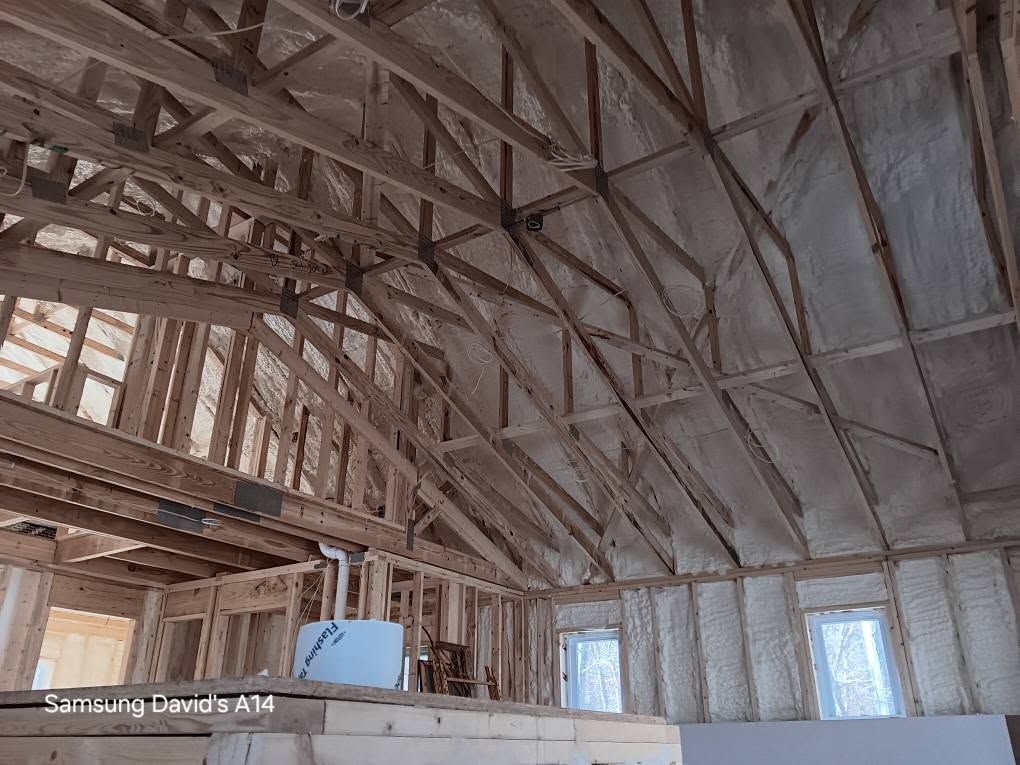
Gaps That Insulation Alone Cannot Fix
Air Sealing in Versailles for homes losing conditioned air through rim joists, top plates, and penetrations
Older farmhouses and rural homes in the Versailles area were framed in an era when air sealing was not a standard step—insulation went in, but the gaps at rim joists, top plates, and utility penetrations were left open. Spray Foam Done Right addresses exactly those leakage points as part of every spray foam job, so the building envelope is tight rather than just insulated. The owner has worked in this trade since 1998 and brings two subcontractors to each job, keeping the crew consistent on every project.
Rather than treating air sealing as a separate add-on, the crew locates leakage points first, seals gaps and penetrations, and then applies foam to the surfaces that need it. This sequencing matters because foam applied over unsealed gaps does not stop air movement—it only slows it. By addressing the envelope as a system, each job produces a result that holds over time rather than one that performs partially.
Schedule a free estimate to identify specific leakage points in your home and review the scope of work before anything begins.
What Changes After the Envelope Is Sealed
The crew works through the building systematically: rim joists, where the floor framing meets the foundation wall, are among the most common entry points in older rural construction and are sealed before foam is applied to surrounding surfaces. Penetrations for plumbing, electrical, and HVAC are located and closed as part of the same pass. Nothing is left to address later as a separate task.
After the work is finished, drafts that were previously noticeable near exterior walls, floors above crawlspaces, or the boundary between conditioned and unconditioned attic space will be gone. The sealed envelope also means your heating and cooling equipment runs against a fixed load instead of a moving target, which shows up as more consistent temperatures room to room.
Spray Foam Done Right completes air sealing and foam application in the same mobilization, which reduces disruption to the home and keeps the scope of work clear from the start. The free estimate defines exactly what will be sealed, what surfaces will receive foam, and what the finished condition of the building envelope will look like.
What Property Owners Ask About the Work
These questions cover how air sealing is performed and what property owners in older rural construction typically want to know before the crew arrives.
What does the crew look for when identifying air leakage points?
The crew focuses on the structural transitions that are most likely to be open in older framing: rim joists, top plates, the seam where interior partition walls meet the ceiling, and any location where a pipe, wire, or duct passes through a framed cavity. These are the points where conditioned air escapes most consistently in farmhouse-era construction.
How is air sealing different from simply adding more insulation?
Insulation slows heat transfer through a material, but it does not stop air from moving through gaps in the framing. Air sealing physically closes those gaps so that neither heat nor cold air can bypass the insulation layer entirely, which is why both steps are needed for the envelope to perform correctly.
What areas of the home are typically sealed during a spray foam job in Versailles?
In homes typical of this part of Missouri—many of them older rural builds or converted farmhouses—the rim joist cavity, attic top plates, knee walls, and any penetration through the building shell are sealed as part of the standard scope. The specific locations are confirmed on the free estimate walk-through.
Why is the sequence of sealing before foaming important?
Applying foam over an unsealed gap can create the appearance of a complete air barrier without actually stopping air movement. Sealing penetrations and gaps first, then applying foam to the surrounding surface, produces a continuous barrier rather than an interrupted one.
How do you know when the air sealing work is complete?
The finished condition is visible: every identified penetration and structural gap is closed with foam or compatible sealant, the rim joist cavity is fully covered, and no framing transitions are left open. The crew walks the completed areas before leaving so the scope matches what was agreed on the estimate.
Spray Foam Done Right also performs air sealing in Osage Beach, Jefferson City, Sedalia, Lebanon, and Boonville. To review leakage points specific to your home and get a written scope before any work is scheduled, call (573) 216-8500 to arrange a free estimate with the owner.