
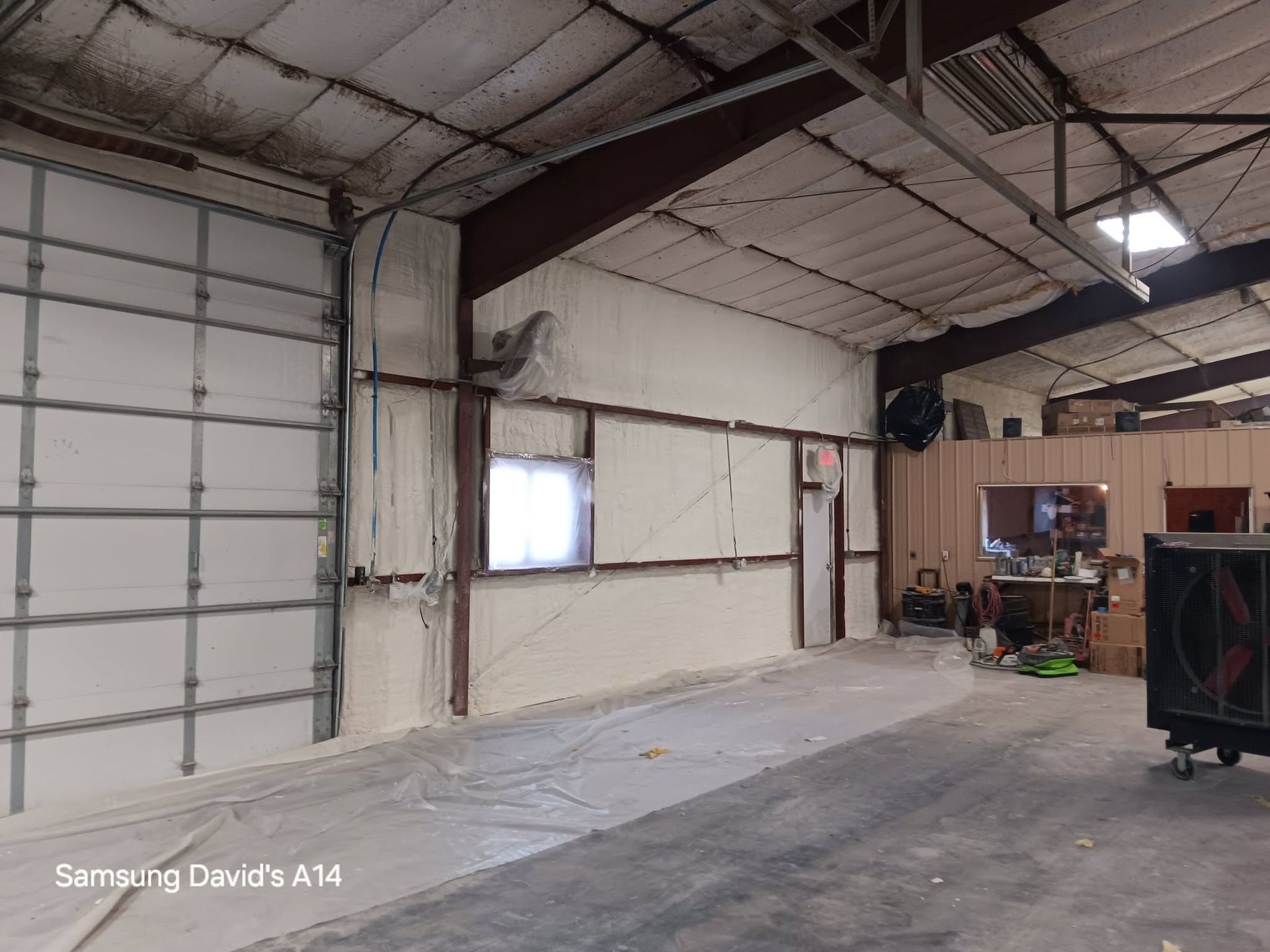
High R-Value and Moisture Control in One Layer
Closed-Cell Spray Foam Insulation in Versailles for homes, barns, and metal buildings requiring a dense air and moisture barrier
Closed-cell spray foam is applied in controlled layers at a set density until the required thickness is reached, producing both an air barrier and a Class II vapor retarder in a single continuous material. Spray Foam Done Right installs closed-cell foam in Versailles following manufacturer specifications for density and thickness on every job—the owner works on each project himself alongside two subcontractors, and that direct involvement is the mechanism for keeping application consistent across the full surface area. The owner has been in this trade since 1998.
Closed-cell foam is applied in passes rather than a single thick coat because excessive thickness in one pass traps heat during the exothermic curing reaction and can compromise the cell structure of the foam. By building thickness in controlled layers, the density spec is met uniformly, the R-value per inch is preserved, and the adhesion to the substrate stays consistent throughout the depth of the application. This is the process detail that separates properly installed closed-cell foam from an application that meets thickness but not density.
Connect with Spray Foam Done Right for a free estimate that specifies the target thickness, layer sequence, and total R-value for your building before the job is scheduled.
What Proper Closed-Cell Installation Requires
The substrate surface must be clean, dry, and at an appropriate temperature before foam is applied—contamination or surface moisture interferes with adhesion at the first contact layer and can cause delamination in service. The crew confirms substrate conditions before application begins. Chemical ratios in the spray equipment are also checked and adjusted to ensure the A and B components are at the correct temperature and pressure for the product being applied, since off-ratio foam cures soft, under-expands, or produces irregular cell structure that reduces R-value and moisture resistance.
When installed to manufacturer specifications, closed-cell foam produces a surface that is rigid to the touch, consistent in color across the applied area, and adherent across the full substrate without soft spots or delaminated sections. The company states that correctly installed closed-cell foam in homes and buildings can reduce heating and cooling costs by 40 to 45 percent, reflecting the combined effect of the high R-value per inch and the continuous moisture barrier. In lake homes and metal buildings around Osage Beach and Camdenton—where high heating and cooling loads and proximity to water make moisture management a practical concern—closed-cell is the most direct way to address both variables in one application.
The foam layer also adds measurable structural rigidity to wall assemblies and roof decks where it is applied, which is a secondary benefit in post frame and metal panel construction that is frequently underused as an engineering consideration. Spray Foam Done Right reviews the application scope, target R-value, and layer sequencing plan with each client on the free estimate before any work is confirmed.
What Property Owners Ask About the Work
These questions address how closed-cell foam is applied, what the finished installation looks like, and how property owners can evaluate whether the work has been done to the correct specification.
How do you verify that closed-cell foam has been applied at the correct density?
Density is confirmed by checking the weight of a known volume of cured foam against the manufacturer's specification. Foam that is under-ratio will be lighter and softer than specified and will underperform on both R-value and vapor resistance. The crew checks application conditions—component temperature and pressure—before and during the job to reduce the risk of off-ratio output.
Why is closed-cell foam applied in multiple passes rather than one thick application?
Each pass of closed-cell foam generates heat as it cures, and that heat must dissipate before the next layer is added. Applying excessive thickness in a single pass traps heat in the foam body, which degrades cell structure, reduces density, and can cause the foam to char internally. Staged passes allow the material to cure correctly at each layer.
What does a properly finished closed-cell application look like on a metal building or barn?
The surface should be uniform in color—typically off-white to pale yellow depending on the product—consistent in texture across the panel surface, and rigid when pressed. Any section that feels soft, shows color variation, or has visible voids indicates an off-ratio or under-thickness area that should be reviewed before the building is closed up.
When is closed-cell the right choice over open-cell foam for a building in this area?
Closed-cell is appropriate when the assembly requires a Class II vapor retarder, when R-value per inch is constrained by the available cavity depth, or when the structure is a metal building or lake home where moisture management is a structural concern. Open-cell is the better fit when vapor permeability is acceptable and acoustic performance is the primary driver.
How is the work area left at the end of a closed-cell installation job?
Overspray and trimmed foam are removed from surfaces that were not part of the scope, equipment is cleared from the building, and the applied surfaces are left in a condition ready for subsequent trades—whether that means wall board installation, interior panel work, or leaving the foam exposed in an agricultural or commercial building.
Spray Foam Done Right also installs closed-cell spray foam insulation in Osage Beach, Jefferson City, Sedalia, Lebanon, and Boonville. Call (573) 216-8500 to speak with the owner directly and get a free estimate that details the application plan, layer sequence, and target R-value for your specific building.