
An Air Barrier Built for Interior Walls
Open-Cell Spray Foam Insulation in Versailles for homes that need air sealing and sound control without a full vapor barrier
Many older rural homes in this part of Missouri have interior partition walls and attic cavities that need an air seal and acoustic separation more than they need the rigid moisture barrier that closed-cell provides. Open-cell spray foam fills those cavities completely, seals air movement through the framing, and absorbs sound transmission in a way that batt insulation—which only partially fills the stud cavity and leaves gaps at edges—cannot match. Spray Foam Done Right installs open-cell spray foam in Versailles with the owner on each job and two subcontractors handling coverage alongside him.
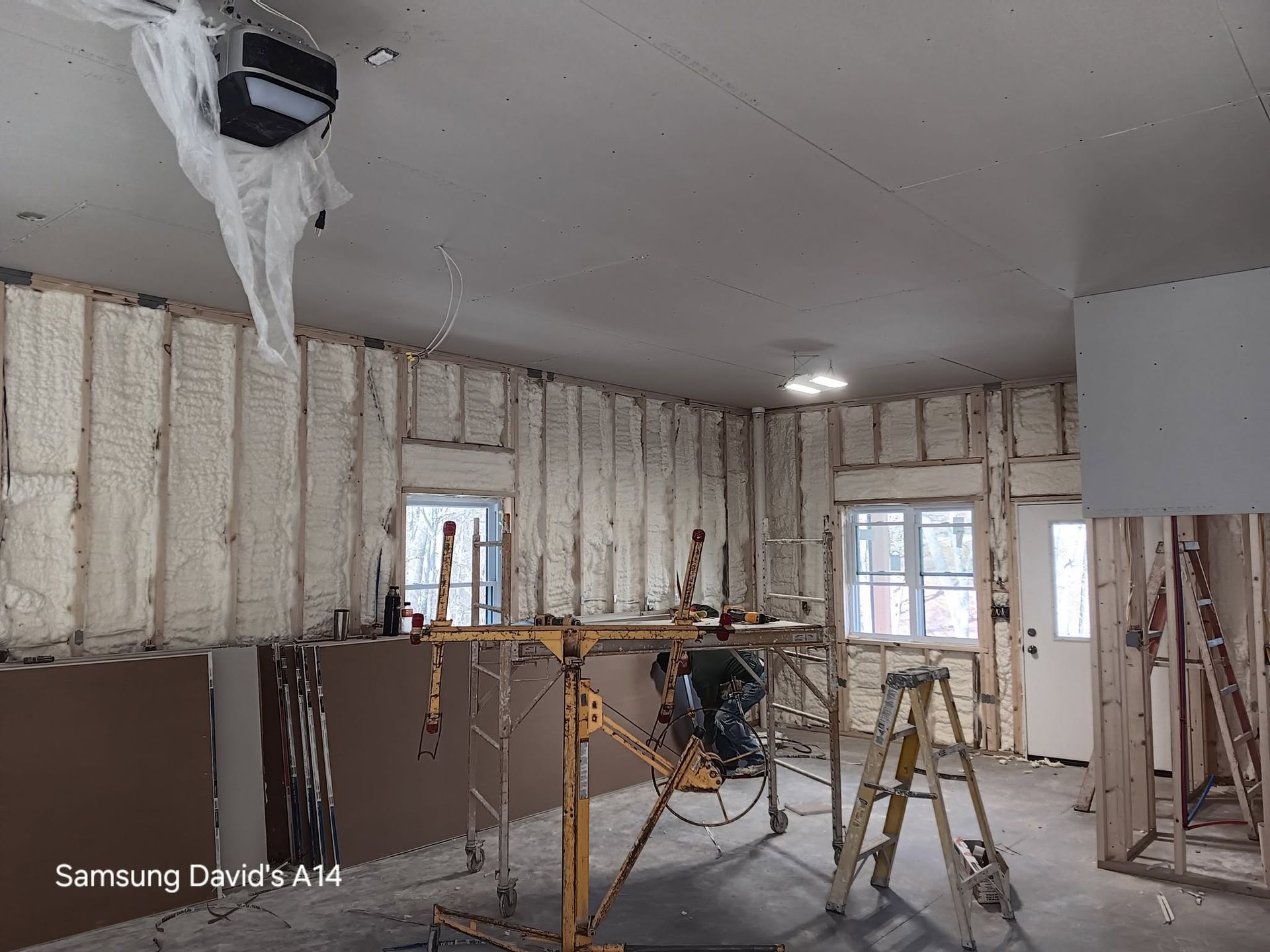
Open-cell foam expands significantly after application—roughly one hundred times its liquid volume—which means it fills irregularly shaped cavities, around plumbing runs, and into framing voids that a cut batt would leave partially exposed. The crew monitors coverage as the application progresses and trims any overfill flush with the framing face so that subsequent wall board installation is not affected by foam that extends past the stud plane.
Set up a free estimate to review which areas of your home are best suited for open-cell and confirm the coverage plan before the crew arrives.
The Difference Between Open-Cell and a Partial Fill
Batt insulation in a stud wall depends on full contact with the cavity surfaces to perform at its rated R-value, and that contact is rarely complete in practice. Gaps at corners, compression around pipes, and voids above blocking all reduce effective performance. Open-cell foam does not depend on contact—it adheres to every surface it touches and expands to fill the cavity geometry regardless of shape. The result is a cavity that is completely filled rather than one that is nominally insulated.
Once the foam cures, the wall cavity is acoustically deadened and the air seal is continuous from one framing member to the next. Noise transmission between rooms drops noticeably, and the air movement that had been pulling conditioned air through interior wall penetrations stops. Spray Foam Done Right includes a coverage check before leaving the job so no section of the work is left thin or open.
Open-cell is the appropriate product where vapor permeability is acceptable or preferred—specifically in above-grade wall cavities in climate conditions where the assembly needs to be able to dry to the interior. In locations where a Class II vapor retarder is required or where the building assembly would benefit from structural rigidity in the foam layer, closed-cell is the right choice. That determination is part of the estimate conversation.
Questions Before Starting Your Project
These questions address how open-cell foam is installed, where it performs best, and what property owners should know about how the work is staged and completed.
What does the crew check during installation to confirm adequate coverage?
Coverage is verified by monitoring the depth of the foam in the cavity as each pass is applied. Attic and roof deck applications are checked with a depth probe or visual inspection of the foam layer against a target thickness mark on the framing, and walls are observed for complete fill from the face of one stud to the face of the adjacent stud.
How is open-cell foam trimmed after it expands past the stud face?
Foam that expands beyond the face of the framing is mechanically trimmed flush with a serrated blade or a hot wire cutter once the foam has cured to a stable condition. This leaves the stud face clear so drywall or wall board can be installed flat against the framing without a bump or void where the foam was left proud.
Why does open-cell foam provide better sound control than batt insulation in the same cavity?
Open-cell foam is a semi-rigid porous material that absorbs and dissipates sound energy rather than simply reflecting it. Batt insulation at standard density reduces some airborne sound but leaves air paths around its edges where sound travels freely. A fully filled cavity sealed at all edges eliminates those paths and performs more consistently across the frequency range.
In what parts of an older rural home does open-cell foam typically perform best?
In homes with wood framing typical of construction in this area, open-cell is particularly effective in interior partition walls where vapor control is not the primary concern, in attic floor or roof deck applications where the assembly needs to breathe, and around irregular framing caused by additions, remodels, or non-standard stud spacing.
What is the visible condition of the work when installation is complete?
The foam fills every framing cavity it was applied to, is trimmed flush with the stud or rafter face where applicable, and shows no open voids, thin spots, or uncovered framing sections. The finished surface has a consistent off-white cellular texture and is ready for wall board installation without additional preparation.
Spray Foam Done Right also installs open-cell spray foam insulation in Osage Beach, Jefferson City, Sedalia, Lebanon, and Boonville. Call (573) 216-8500 to talk through your project with the owner and get a written estimate that covers product selection, coverage areas, and scope before any work is scheduled.