
Attics That Stop Losing Conditioned Air
Attic spray foam insulation in Versailles for ventilated attics that pull heat out of the living space below
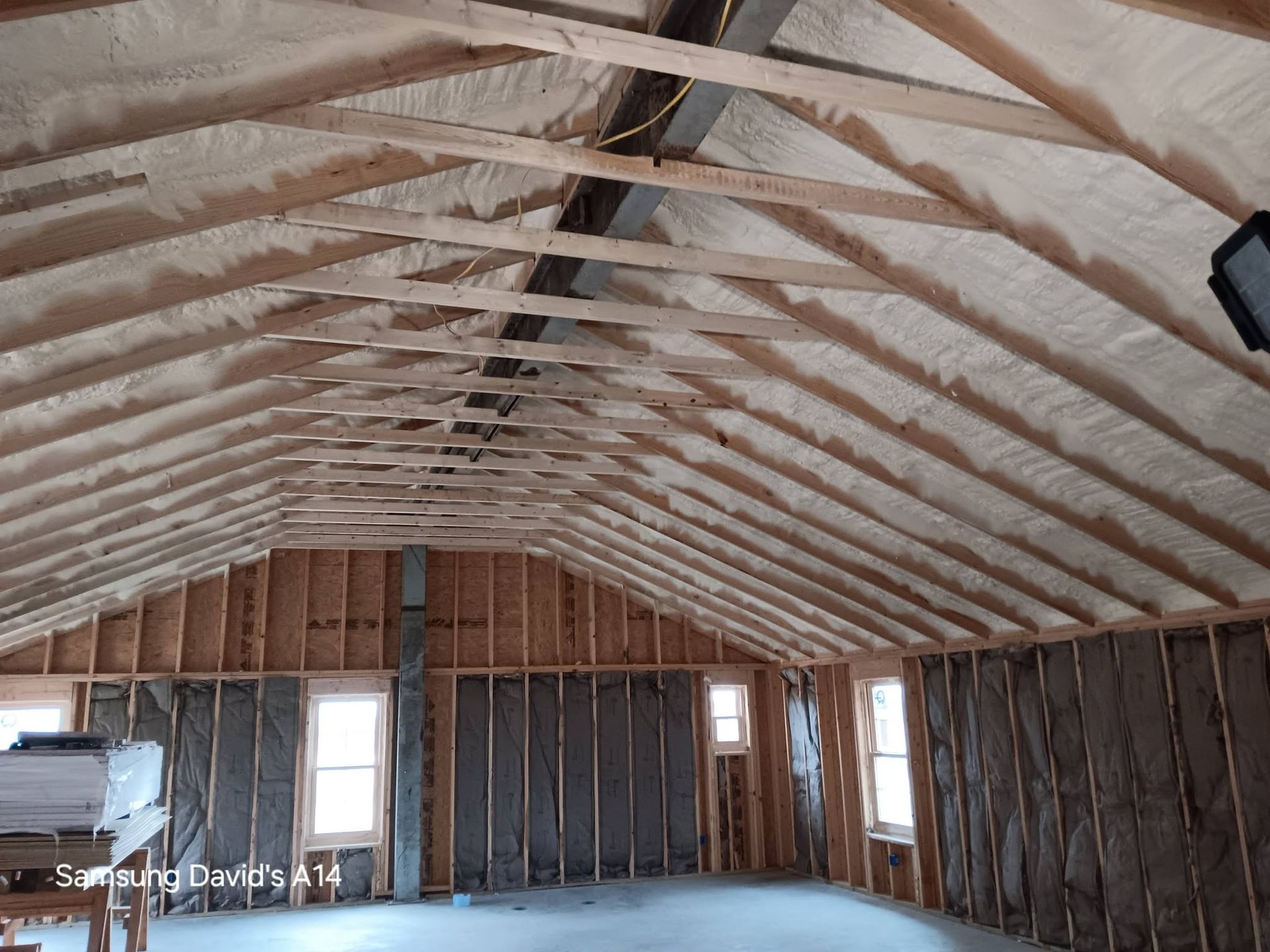
Spray Foam Done Right has been sealing and insulating attics with spray foam in Versailles since the owner entered the trade in 1998, and the approach here differs fundamentally from standard ventilated attic work. Rather than treating the attic as an outside space separated from the home by insulation on the floor, the crew applies foam to the roof deck and rafters so the attic becomes part of the conditioned envelope. Homeowners with older homes where the attic runs noticeably warmer or cooler than the living space below are typically the ones who benefit most from this conversion.
Before any foam is applied, the owner walks through the project with the homeowner and explains why a sealed attic outperforms a ventilated one for most residential applications. The crew then seals the roof deck and rafters, closing the gaps where conditioned air was escaping rather than simply adding a layer above the ceiling joists. That sequencing matters because foam applied to an already-leaking deck without addressing the structural gaps underneath produces a weaker seal than one built from the deck surface outward.
Request a free estimate to review your attic's current configuration and identify where the thermal boundary can be tightened.
How a Sealed Attic Differs From a Ventilated One
A ventilated attic is deliberately open to outside air through soffit and ridge vents, which means the temperature in that space tracks closely with the temperature outdoors. Any ductwork, air handlers, or ceiling penetrations running through that space are operating in unconditioned air, and every small gap in the ceiling plane becomes a direct path for that air to move into the living area. Applying closed-cell or open-cell foam to the roof deck and rafters closes that pathway and shifts the thermal boundary from the ceiling to the roofline.
After the work is completed, the attic temperature stabilizes much closer to the rest of the house. Ductwork that previously sweated or lost significant output because it was running through extreme heat or cold now operates in a conditioned space, and the ceiling below no longer acts as a barrier trying to hold two extreme temperatures apart. Homeowners often notice that rooms directly below the attic maintain more consistent temperatures once the roof deck is sealed.
The foam type selected for the roof deck affects both the R-value achieved per inch and whether the assembly requires a thermal barrier before it is covered. Spray Foam Done Right evaluates those requirements during the walkthrough so the application meets both performance targets and applicable building standards before walls or ceilings are disturbed.
What Homeowners Ask About Attic Spray Foam
The questions below focus on how attic spray foam work is actually performed and what to watch for during and after the job. Many homes in Versailles and the surrounding area were built with conventional ventilated attic assemblies, so the conversion process and its specific steps come up frequently.
What does the crew apply foam to in an attic, and why does the location matter?
Foam goes onto the roof deck and the underside of the rafters rather than the attic floor, which moves the thermal boundary to the roofline and brings the attic itself into conditioned space instead of leaving it exposed to outside air.
How do you prepare an attic before spray foam is applied?
The surface needs to be dry and free of debris, and any existing batt insulation on the attic floor is typically removed or left in place depending on the design approach, since leaving it can create unintended moisture trapping between two insulation layers.
What is the difference between open-cell and closed-cell foam for a roof deck application?
Closed-cell foam achieves a higher R-value per inch and acts as a vapor retarder, which makes it the preferred choice when the assembly needs to manage moisture as well as temperature; open-cell foam is more vapor-permeable and is typically used where the design allows the assembly to dry toward the interior.
How do you know the foam has been applied at the right thickness?
The installer measures depth during application using thickness gauges, and the finished pass is inspected before the crew leaves the job site to confirm it meets the specified R-value.
Why do older homes in this area often have ventilated attics that lose significant conditioned air?
Many homes built before the 1980s used attic ventilation as the primary moisture management strategy rather than vapor control layers, which made sense for the materials available at the time but left large openings that also allow conditioned air to escape continuously.
Spray Foam Done Right also performs attic spray foam insulation in Osage Beach, Jefferson City, Sedalia, Lebanon, and Boonville. To start the conversation about your attic assembly, call (573) 216-8500 or ask about a free on-site estimate so the scope can be confirmed before any work is scheduled.